 Bluffton Golf Cart Repair
Golf Cart Brake & Tire Service in Bluffton
Bluffton Golf Cart Repair services golf cart brakes and tires at your home: adjustments around $75, shoes and drums $100–$250, full brake overhauls $200–$400, and tires $75–$150 each installed ($300–$600 for a set of four). One visit, parts on the truck, anywhere in greater Bluffton, Sun City Hilton Head, Okatie, and Hardeeville.
Brakes and tires are the quiet wear items of the Lowcountry cart. Batteries get all the attention because they’re the big ticket, but the two systems that actually keep you safe on Buckwalter-area streets wear on a faster clock here than almost anywhere inland, and for reasons specific to this place.
Why the Lowcountry eats brakes and tires
Sand is an abrasive, and it’s everywhere. Bluffton’s soil is sandy, its cart paths are often crushed shell or sand-swept asphalt, and marsh-side communities add a fine grit that gets into everything. Inside a drum brake, that grit acts like lapping compound: it scores drums, chews shoes, and packs into the adjuster mechanisms. On tires, abrasive surfaces scrub tread that smooth pavement would leave alone.
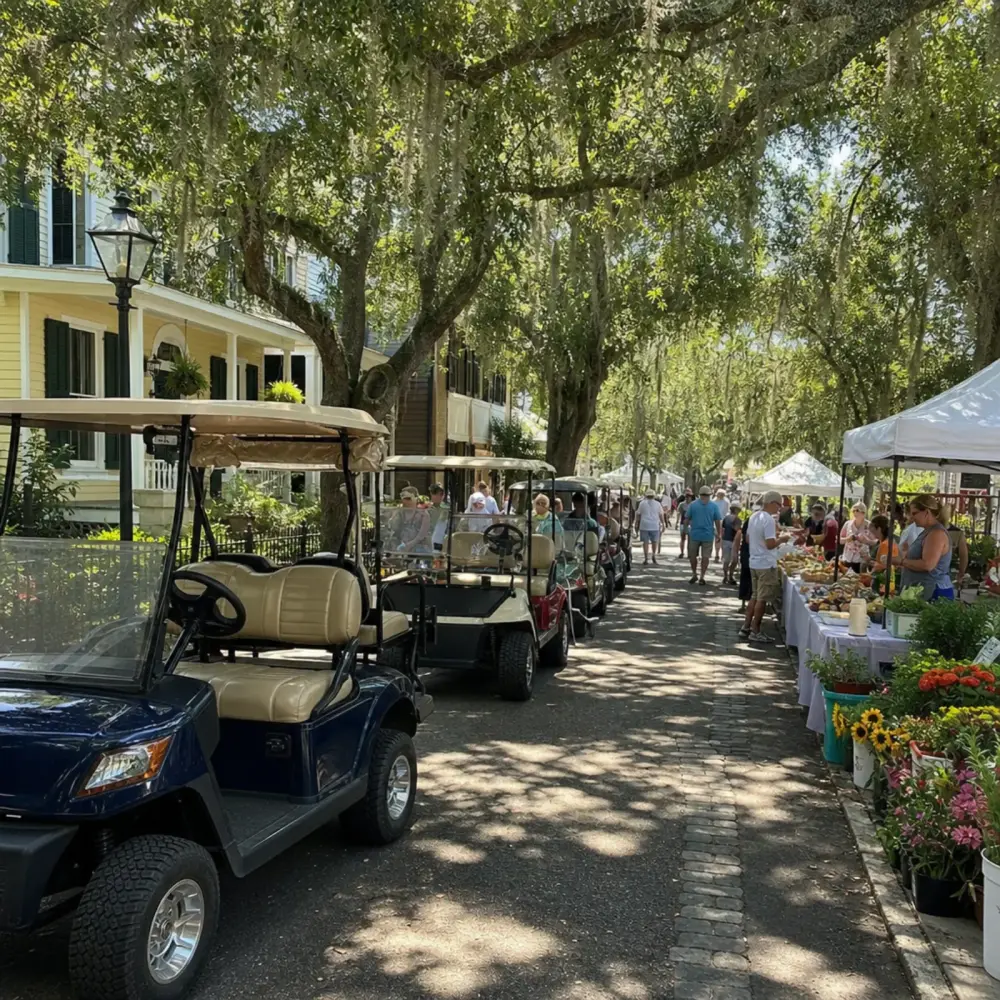
There is no off-season. Inland carts hibernate; Bluffton carts run twelve months. A cart doing daily Sun City errand loops or Old Town runs to the farmers market accumulates real mileage, and brake shoes and tire tread spend, not save.
Humidity seizes what sand doesn’t wear. Brake cables, cam levers, and adjusters that sit unused, the snowbird cart problem, corrode and seize in a damp garage. The first stop after a summer away is often grabby, uneven, or weak because hardware rusted in place, not because shoes wore out. A tune-up after storage catches it cheap.
Weight went up. Seat-belt kits, rear seats, coolers, and two adults put a modern cart near its design limits. Since Bluffton’s specialized-vehicle ordinance put belts on every occupant, more carts carry more passengers on public streets, one more reason marginal brakes aren’t acceptable.
Brake service, what we actually do
Golf cart brakes are mostly mechanical drum systems: shoes inside rear drums, actuated by cables from the pedal. Simple, which means they respond beautifully to being maintained and fail predictably when they aren’t.
- Adjustment (~$75): take up cable slack and reset shoe clearance so the pedal bites high and even. The right first step for “pedal goes too far down” on shoes with life left.
- Shoes and drums ($100–$250): replace worn shoes; turn or replace scored drums. Sand-scored drums are common enough here that we check drum surfaces every time.
- Full overhaul ($200–$400): shoes, springs and hardware, cable service or replacement, adjuster rebuild, then adjustment. The right call for a cart that sat, or one that’s never had brake work in years of coastal service.
Every brake job ends with a rolling test, including a hard stop, before we hand it back.
Tires: what’s on the truck
We stock the common cart sizes in standard turf/street tread and can source lifted and low-profile styles. Installed on-site, $75–$150 per tire, with valve stems checked and pressures set. Signs you’re due: visible cords or flat-spotting, squared-off shoulders from underinflation, cracking sidewalls from sun and heat, or a cart that wanders or pulls. Uneven wear across the rear pair sometimes points at a dragging brake on one side, which is exactly the kind of thing a combined brake-and-tire visit catches, and why we quote them together when both are tired.
Two front tires and an alignment on a 14-inch street-tire cart
Newer carts such as ICON and EPIC models, and many lifted carts, ride on 14-inch wheels with radial street tires instead of the small turf tires older carts use. The sidewall tells you what to replace them with. On a tire marked 23x10.50R14 84J, 23 is the overall height in inches, 10.50 the tread width in inches, R means radial construction, and 14 is the wheel diameter. The 84 is a load index, 500 kg or about 1,102 lb per tire, and the J is a speed rating of 62 mph. A replacement should match the size and carry a load index of 84 or higher, and buying the pair together keeps both fronts at the same diameter and tread depth.
Look at the old tires before ordering. Fronts that wore down evenly across the tread simply aged out. Fronts worn on just the inner or just the outer edge are telling you the toe setting is off, and two new tires mounted on the same setting will scrub sideways and wear the same edge. Toe is the angle of the front wheels toward or away from each other, and on most carts it is the only alignment setting there is, adjusted at the tie rod ends. A lift kit, a hard hit on a curb, or a worn tie rod end moves it.
Set the pressure from the manual, not the sidewall. The number molded on a tire is its maximum, not the cart’s setting. ICON’s i40L owner’s manual specifies 25 psi and lists tire pressure, tread depth and steering as a check before every drive, plus a monthly check of every nut and bolt. Under-inflated radials on a loaded cart wear both edges, which looks like an alignment problem and is not one.
For a visit like this, the useful details to send are the tire size off the sidewall, a photo of the worn tread on each front tire, and whether the cart has a lift kit.
One front wheel pointing a different way
Toe wear is slow and you see it on the tread. A front wheel you can see is crooked, one pointing straight ahead and the other angled off with the steering wheel centered, is a different problem: something in the steering linkage is bent or loose. On a golf cart that is usually one of three parts:
- A bent tie rod, the bar that links the two front wheels. A curb, a deep pothole, a trailer strap cinched across it, or a bump in a tight cart garage will bow it.
- A worn or loose tie rod end, the ball joint at each end of that bar. Salt air and years of sand get in, the joint wears, and the wheel wanders.
- A bent spindle, the part each front hub mounts to. Less common, and usually from a harder hit.
A quick check: with the front of the cart lifted, hold the crooked wheel at nine and three o’clock and rock it. Clunking or free play points at a tie rod end; a wheel that is solid but still angled points at a bent part. Either way, keep trips short until it is looked at. A wheel that is pushed sideways scrubs a tire bald in weeks, and a worn joint that lets go takes the steering with it.
The repair is the damaged part replaced, then the toe set with both wheels straight. When you call, tell us which wheel is off, roughly when it started, and whether the steering wheel now sits crooked when you drive straight.
Bundling and honest sequencing
If the cart is getting a battery pack anyway, brake and tire work in the same visit shares the trip fee, the $50–$100 service call is applied once, toward the whole job. And we sequence honestly: if the pedal problem is a $75 adjustment, you won’t hear a $400 overhaul pitch; if the drums are scored to the point new shoes would be wasted, we’ll show you the drum and explain why the middle option is the false economy.
One diagnostic note from the electrical side: a cart that feels weak isn’t always the pack. Dragging brakes load the motor exactly like voltage sag does. The controller works harder, range shrinks, and owners start pricing batteries. Part of every weak-cart diagnostic is spinning the rear wheels and checking brake drag before anyone talks about a new pack or controller. It’s a two-minute check that has saved more than one owner a thousand dollars.
Book a brake or tire visit
Tell us the symptom (soft pedal, squeal, pull, visible wear) plus the cart brand and whether it’s lifted. We’ll bring the likely parts and handle it at your driveway, same-day or next-day across Bluffton, Sun City Hilton Head, Okatie, and Hilton Head Island.
Frequently Asked Questions
How much does golf cart brake work cost?
A brake adjustment runs about $75, shoes and drums $100–$250, and a full overhaul (shoes, hardware, cables, adjustment) $200–$400. All done at your driveway, with the trip fee applied toward the repair.
What do new golf cart tires cost installed?
$75–$150 per tire installed, $300–$600 for a set of four. Lifted carts and low-profile street styles sit at the top of the range. We bring the tires to you and mount them on-site.
My brakes squeal, is that serious?
Sometimes it's just sand or brake dust in the drums, which our sandy paths supply constantly; sometimes it's shoes worn to the backing. A squeal that goes away might be debris; one that stays means inspection. On a cart carrying two people in golf cart traffic, don't sit on it.
Why do my tires wear out so fast here?
Year-round riding plus abrasive sandy surfaces. There's no off-season to rest the tread, and crushed-shell and sand-swept paths scrub rubber harder than smooth pavement. Underinflation accelerates it, soft tires on a heavy cart square off fast.
My cart needs two new front tires. Should it get an alignment too?
Check the old tires first. Wear on only the inside or only the outside edge of both fronts means the toe setting is off, and a new pair mounted on the same setting wears the same way. Even wear across the tread means the tires simply aged out and an alignment is optional. On most carts toe is the only adjustable setting, set at the tie rods, so the check is short. A lift kit changes it, so a lifted cart is the one most likely to need it.
Do carts need brakes checked for the new Bluffton ordinance?
The ordinance's equipment list is seat belts, mirror, lighting, decal, and insurance, it doesn't add a brake standard. But it exists because carts share real roads with cars, and mechanical brakes on a belted, loaded cart are the one system you never want marginal. We check them with every job.